Heat Islands
Bombing raids had decimated European cities in World War II. The deadly fallout from the destruction obviously affected the lives of the survivor. And as it turned out, the bombs also affected the local weather. The available evidence suggested that the decrease in building mass led to decreases in temperatures.
The sample, however, was “too skimpy for scientific assessment,” recalled the late Helmut Landsberg, one of the world’s most important figures in climate research and biometeorology, the science of how the body and the atmosphere interact. That skimpiness of the data set was the result of a positive development: After the war, governments went about the business of rebuilding their cities.
Two decades later, Landsberg would seize an opportunity to document the evolution of an “urban heat island,” in which buildings and paved surfaces raise temperatures in the local environment. Today it is well understood that in summer, cities become low-grade hot plates that add fire to life-threatening heat waves.
That realization, in significant part, is due to the literally groundbreaking work of Landsberg.
Discovering the heat islands,
The spadework that would lead to the deeper understanding of the phenomenon began in the early 19th Century. A British pharmacist, Luke Howard, used temperature measurements to show that the London environment was substantially different from that of areas outside the city. He astutely attributed the differences to London’s “artificial warmth.”
Heat-taming moisture in the city was “very speedily exhausted,” and rather than being wide open, it was crowded with buildings that absorbed heat.
My attention was drawn to Howard’s work by another non–meteorologist, a Benedictine monk, the Rev. P. Albert Kratzer, who presented a comprehensive world tour of urban warming in The Climate of Cities, published in 1937 and updated 20 years later. He invoked the term “mesoclimate.” While the traditional term “microclimate” suggested that the warming effects had “no relation to its neighbors. … influences of the city on large–area climate, and on the course of the weather in general, are completely within the realm of possibility,” he wrote.
As it turned out, recent research by the University of Georgia’s J. Marshall Shepherd and others has documented that all that heat rising from cities can affect rainfall in communities downwind from the urban cores.
A decade after Father Kratzer’s updated treatise, and the minting of the term “urban heat island” by British climatologist Gordon Manley, Landsberg undertook the task of attempting to quantify just how much development could contribute to warming.
He found the perfect opportunity, in a sparsely settled area of Maryland about 20 miles southwest of Baltimore.
Measuring the effects
Landsberg, a native German who received his doctorate from the University of Frankfurt, came to the United States in 1934 after accepting a position at Pennsylvania State University, where he taught geophysics and meteorology. He later moved on to the University of Chicago, and to the University of Maryland in 1967.
Fortuitously for Landsberg and future researchers who would build upon his work, that was the same year that a grand experiment in urban design officially began on what had been about 15,000 acres of farmland and open space in unincorporated Columbia.
The land, about 20 miles south of the Maryland campus. had been purchased by pioneer mall developer James Rouse, who said he wanted to build “a garden for the growing of people,” a place where “a man, his wife, and family can live and work and, above all else … grow in character, in personality, in love of God and neighbor and in the capacity for joyous living.” It would be “economically diverse, poly–cultural, multi–faith and interracial.”
Landsberg had a grand experiment of his own in mind for the area around the Columbia post office, which as late as 1912 was delivering mail to only 20 residents.
The Rouse Company agreed to allow Landsberg and his team to set up instrument arrays that captured temperature and other weather variables in what Landsberg described as a “partly wooded” location that was “no more than a crossroads.” The project began in 1968, when the Columbia population was about 200.
Landsberg collected data until 1975 in a period when the population increased 100-fold, to 20,000, during a robust period of construction.
In a paper published in 1979, he observed that the data “confirmed in most respects earlier deductions:” Urbanization creates low-grade hotplates.
Naturally, or rather unnaturally, the most significant increases in temperatures occurred in the vicinity of the shopping mall and the town center.
“A rich fabric of microclimates,” created by the mix of stream valleys, woods, hills and flora, essentially was erased and replaced by a new microclimate driven by building density.
Development replaced moisture-retaining vegetation that was part of nature’s air-conditioning system. When water evaporates it gives off a cooling effect: Think of sweat evaporating from the skin. Building materials soaked up the sun’s heat during the day and gave it up only reluctantly after sunset.
“An unmistakable urban heat island has developed that is quite notable nocturnally,” he wrote, identifying a phenomenon that has become an ongoing concern among heat-mortality experts.
For the attention given to heat indices and the dangers of exertion on hot days, it is the nights that are deadlier in the cities, particularly in those rowhouse neighborhoods where elderly people live – and die — alone.
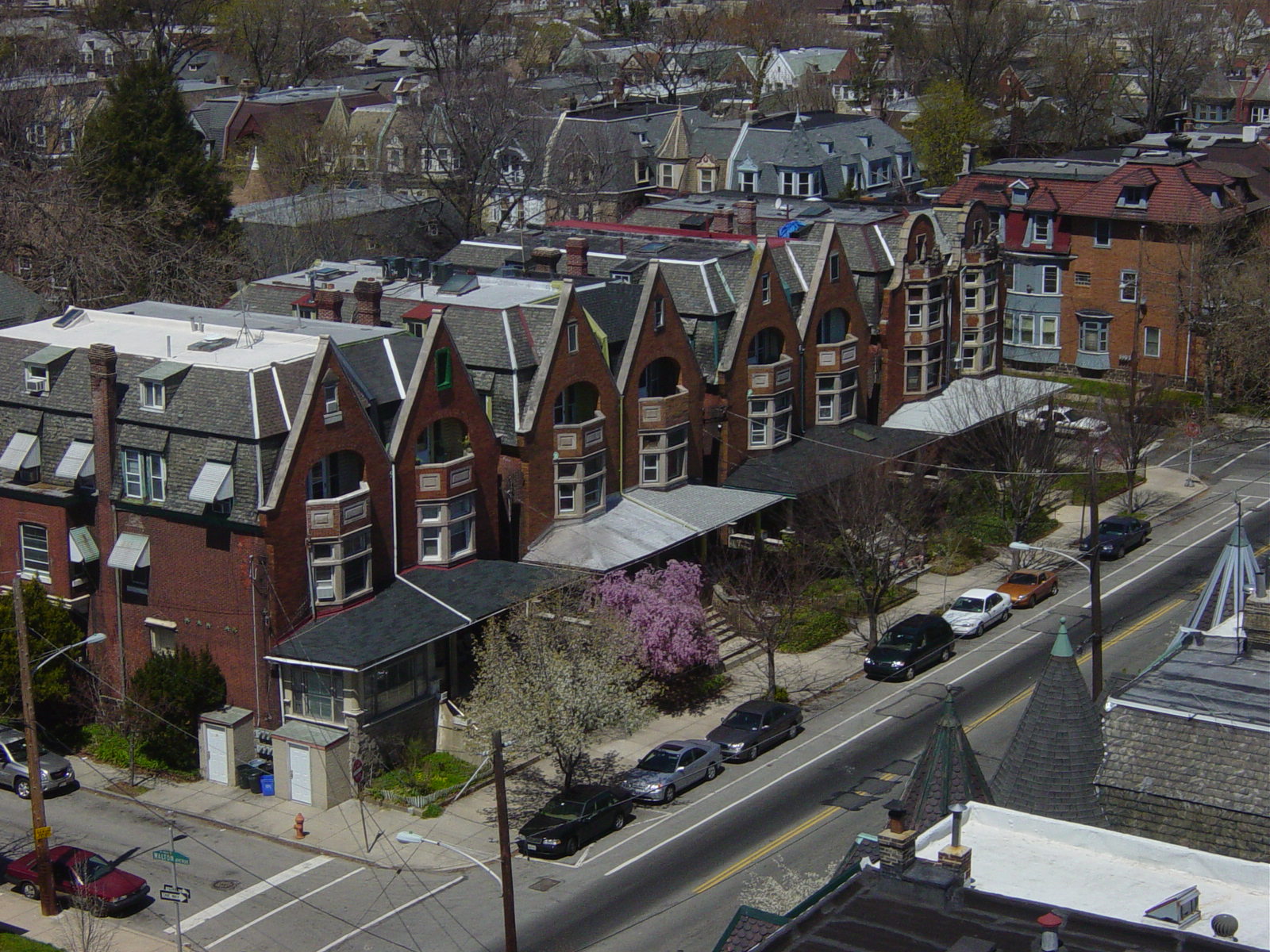
As Dr. Larry Robinson, formerly with the Philadelphia Health Department, told me, brick rowhomes can become killer “brick ovens” that store daytime heat that doesn’t dissipate during hot nights. That leaves them susceptible to rapid heating when the sun comes up in the morning.
Unsurprisingly, the Environmental Protection Agency estimates that temperatures in the cities can be several degrees Fahrenheit warmer than in surrounding areas. However, all weather is local. As Father Kratzer observed, “Every street has its own climate.”
The term “hot neighborhood” has taken on a very different meaning during summers in the city.
Death in the city
Landsberg’s findings were harbingers of the U.S. heat wave disasters that resulted in hundreds of deaths in Philadelphia, in 1993, and Chicago two years later. Then, in 2003 one of the worst natural disasters in human history swept over Europe with 10s of thousands of deaths attributed to the heat.
Powerful evidence indicted urban heating as a mass killer in that tragedy. Using satellite imagery to detect thermal patterns, a team of French researchers documented elevated temperatures in the vicinity of buildings.
They also emphasized the overpowering importance of hot nights. Among the elderly, they concluded, “exposure to a high nighttime temperature over several days increases the probability of death during a heat wave in urban conditions.” Conversely, they said, “daytime temperature is less important.”
Remedies
That an increase in development is going to result in raising local temperatures is inevitable, but cities have become savvier at mitigating the effects. Some of the steps they are taking evoke Landsberg’s observations about what the Rouse company could have done differently in the Columbia experiment.
For example, he said bulldozers had erased “a large number” of mature trees that could have provided a variety of benefits. Beyond the aesthetic considerations, tree canopies would have supplied heat-reducing shade, and like the ground vegetation, the water-bearing leaves contributed to that natural air-conditioning system. Isolated old trees and the trees of Symphony Woods were the only survivors of the arboreal decimation.
Landsberg said that instead of Columbia’s artificial lakes, Rouse cold have created parkland and spared some trees. The lakes, while aesthetic additions, weren’t large enough to have “appreciable” cooling effects: They might make differences in areas within 200 feet of the water, but that was about it, he reasoned.
Landsberg was no fan of the parking lots. He said it would have been better to build garages, which would have required considerably less ground cover.
Overall, Columbia was no role model for mitigating urbanized heating, showing “no significant advances over other towns of comparable size.” He concluded that Columbia’s failure to take more aggressive measures to blunt the warming effects of development was “inexcusable.”
While plenty of information was available about what could have been done to reduce heating, it was “largely ignored in planning.”
The tragedies of Paris, Chicago, and Philadelphia attest to the fact that Landsberg was on to something.