Pollen: Who’s Counting?
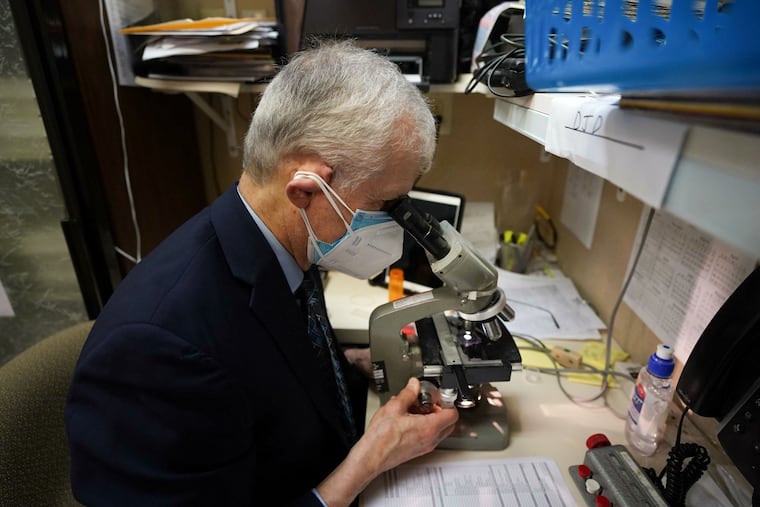
Dr. Donald Dvorin’s day started at 8 a.m. with a trip to the roof of his office building.
From an apparatus that looked like a miniature, three–legged satellite, its most-prominent feature a wind-catching fan blade, he removed a microscope slide that was layered with an adhesive.
After removing the slide, he returned to his office and applied droplets of a dye, Calberla’s stain – a combination of glycerol, ethanol and distilled water. His tiny captives were revealed.
With the magnified evidence, Dvorin was able to estimate how many grains of pollen had passed through a cubic centimeter of air in the previous 24 hours, which would be reasonably representative of the concentrations within a 20– to 25–mile radius of the observation site.
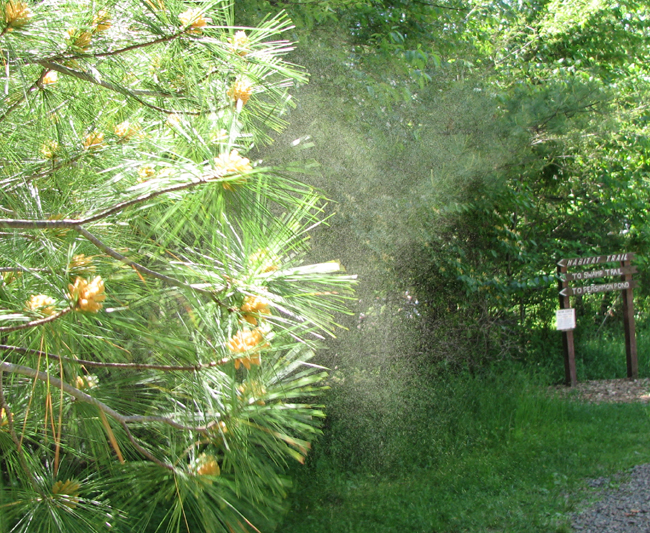
Atop so many car hoods and mailboxes and patio furniture, pollen appears as a nondescript sheen. Projected onto a monitor screen in Dvorin’s office, the assembled ovular cedars and near–circular junipers, that look to be stenciled with snowflake–like hexagons, are evocative of a Paul Klee painting.
His mission on that particular March morning was complicated by the sheer quantities of the prisoners.
The volume was so high that he couldn’t count it all in one sitting. He had to break off for his day job, which is treating patients with respiratory symptoms, no doubt aggravated by the very pollen he was counting. He returned to the microscope, then back to the patients. Finally, at 3:45 p.m. he sent out a mass email with the headline, “Tree Pollens Extreme.”
For his effort on this day and others during the pollen seasons, he is paid exactly $0.00. His pollen–counting enterprise operated at a loss.
No more.
Moving on
The following March, as I always did when the tree season was about to start, I checked in to find out when he would start posting his counts. His answer was not what I wanted to hear. He informed that his counting days were over. He had decided to join the ranks of so many other former pollen counters who have left the network. The impetus in his case was the purchase of his practice by one of the big players in the medical-industrial complex. Pollen counting wasn’t in the program, and no one else would be picking up his trap.
“Very, very few allergists want to get into this,” said Dvorin.
Fiona Lo, a researcher at Washington State University, said she understood why doctors would want to stop with the counts: “Their main focus is the patient.”
A matter of time
Dr. Timothy Craig, a professor of medicine and pediatrics in allergy and immunology at the Milton S. Hershey Medical Center, counted pollen for 17 years. In his time, his front-porch trap in upstate Pennsylvania captured pollen masses as thick as “oatmeal.” After a hurricane blew through, “I actually saw pollen grains from palm trees.”
All in all, he said he found pollen counting “pretty enjoyable.”
But a few years back, he decided to drop out.
“It’s very labor–intensive and time–intensive,” said Craig,
In addition to the daily trap–setting and morning-after analysis, the mechanisms require preparation and maintenance. For the Burkhard trap, considered the gold standard, the operating manual written by Estelle Levetin, a highly regarded aerobiologist and professor emeritus at the University of Tulsa, covers 16 pages.
Pollen-counting is not a recreational activity.
A paradox in a warming world
What’s left of the National Allergy Bureau’s certified counting network are fewer than 70 stations for 330 million Americans.
Washington California and Oregon — a three-state area covering more than 350,000 square miles, with 15 percent of the nation’s population – have a grand total of nine.
In stations per-capita, the United States ranks way before other nations that have observation networks, including Italy; France; Spain and Germany. Japan, the world leader, has a station for about every million people, quadruple the per–capita density of the National Allergy Bureau network.
Lo and other pollen researchers view the United States as seriously lacking in reliable, controlled monitoring stations. “Observations are sparse, sporadic, not–standardized,” said Lo, “often hard to come by.
“It is disappointing that there isn’t a better observation system.”
Automated counting systems show promise, but Levetin and Dvorin are among those who hold that the sensors remain works in progress and aren’t ready to replace the ground-truth machines — and their analysts — in tracking the careers of these seasonal tormentors.
The pollen forecast
Pollen still is guarding some of its secrets, and pollen’s effects have everything to do with that elusive medium – the atmosphere – which at times can act as an ally of the allergenic. More pollen won’t necessarily mean more days of suffering, said Levetin. A warming world is a wetter world with more water evaporating and supplying more moisture for storms.
Forecasting the onsets and durations of precipitation remain among the most difficult challenges in meteorology, especially during the pollen season when the atmosphere tends to be in transition.
Researchers do agree that the climatology of pollen seasons is changing. The seasons are indeed growing longer, and that the pollen volumes are swelling along with levels of plant-friendly carbon dioxide.
It’s not the best time to be losing pollen-counters.